
MHCA History
1693
George Mason II erected a foundation to serve as a fort to protect settlers against the Doeg (sometimes known as Dogue) Indians. Located in what is now Fairfax County, it is probable that the first part of the original Hollin Hall was built on the fort foundation in the early 1720s. (Like early history? See below for more*.)
1721
George Mason III married Ann Thomson and took up residence on this site.
1735
George Mason IV inherited 2000 acres for a plantation contiguous to George Washington’s Mount Vernon, where he built Gunston Hall.
1791
George Mason IV spent years building a new, larger home for his son, Thomson, about 200 feet from the original house. It was named Hollin Hall after a family home in Yorkshire, England. Thomson and his wife Sarah McCarty Chichester lived in the house until his death in 1820.
1827
The main building burned, resulting in the "spinning house" being used again as the main residence. This building is still in existence and is known as "Little Hollin Hall", located on six acres of land on what is now Sherwood Hall Lane.
1852
Hollin Hall and 500 acres of land was purchased by Edward Curtis Gibbs, a Quaker sea captain and farmer who hired both black and white farmers to demonstrate plantations could be made profitable without slave labor.
1860-65
During the Civil War, being considered a no-man’s land, Mason Hill was alternatively occupied by both Northern and Southern troops. After the war, it was divided among several owners.
1881 - A Thomson family member bought 300 acres from Mr. Gibbs, where the Thomson Dairy was established.
1914 - Thomson sold his estate, including six hundred acres to Mr. and Mrs. Harley Peyton Wilson.
1919 - A new mansion was completed, and the following year work was completed on other buildings and a formal garden.
1929 - A guest house and swimming pool were added, and over the years provided a retreat for Mrs. Woodrow Wilson, Herbert Hoover, and other dignitaries. Eventually, the guest house became the chapel for Mt. Vernon Unitarian Church.
1934 - Mr. Wilson died, and the estate was put up for sale.
1941 - Mr. Merle Thorpe purchased eighty-nine acres of the property that contained the mansion and turned it into a chicken and turkey farm.
1958 - The Mount Vernon Unitarian Church purchased 10.34 acres (with buildings) for its religious programs.
1978 - The new housing development on Mason Hill left intact ten acres of buildings and grounds for the Mt. Vernon Unitarian Church and provided a through street (Mason Hill Drive) from Fort Hunt Road to Range Road, giving direct access to the Hollin Hills and Hollin Meadows residential areas.
1984 - The final three lots were sold for new houses on Mason Hill Drive and Windmill Lane. The Unitarian Church began a major construction program that involved the sale of the old chapel and demolition of several smaller buildings.
1993 - Hollin Hall was placed on the Fairfax County Inventory of Historic Sites.
*More early Mason Hill History
Before the arrival of Europeans on the shores of Virginia, Native American Tribes inhabited this area, including Mason Hill. The Doegs settled in the Northern Neck of Virginia which included the land along the Chesapeake Bay between the Potomac and Rappahannock Rivers. The Doegs were fishermen and corn growers for thousands of years before Englishmen moved north from Jamestown into what is now Northern Virginia.
Increasing settlements pushed the Indians west as land was cleared for tobacco and wildlife was also pushed out. By the mid 17th century settlers had laid claim to most of the land. In 1649 England’s exiled King Charles II granted more than 5 million acres of the area to seven of his loyal followers. The grants were converted to leases following Charles’ restoration to the throne. In 1671 there were six leases on the land. Thomas, Lord Culpepper, son of one of the original grant holders, purchased four of the leases; in 1688 the land was granted in perpetuity to him.
Lord Culpepper died 1 year later, leaving the land to his daughter, Catherine, who married Thomas, the 5th Lord Fairfax, the following year. Lord and Lady Fairfax were proprietors of the land. They had patents or titles to the land in exchange for tobacco and the promise to build a house and either plant 1 acre or keep stock within 3 years. If the requirements were not met, the land was to be reclaimed. This system was kept in place until after the Revolutionary War. After the war, land was sold, a survey was taken, conflicting claims were resolved and a land grant was recorded in the Northern Neck grant book. New owners paid a 2 shilling rent for each 100 acres of land granted to them. If they were delinquent in payment after two years the grant was canceled. In 1677 the first land patent, where Mason Hill, Hollin Hall and the MVUC is located, was granted to George Brent, who served as the King’s Attorney in the colony of Virginia. There is no record that George Brent established a residence, preferring to let a tenant settle and plant tobacco on the land.
The land where Hollin Hall, Mason Hill and the MVUC is located changed ownership several times between the Ball, Musgrove and Carlyle families. In 1748, Ball sold the 121 acres to Sampson Darrell for thirty pounds. Darrell later sold the property to George Mason IV for 100 pounds. Mason IV built a dwelling on the property but did not live in it. In 1786, he gave his son Thomson 4 tracts of land totaling 676 acres, which included 535 acres previously belonging to George Mason III and the 121 acres and dwelling he bought from Darrell. During Christmas of 1788, Thomson Mason, his wife Sarah and their son Thomson moved into the property, which was a favorite hunting ground for the local gentry, including George Washington.
His family growing, Thomson Mason built a new residence close to the dwelling referenced above. The new residence was called Hollin Hall, which stands today next to the Mount Vernon Unitarian Church and where the MHCA holds meeting and social functions. Hollin Hall was named after the Mason family home in England owned by his grandmother, Ann Thomson Mason, wife of George Mason III.
Hollin Hall was erected as a 2-story dwelling with porticoes on the front and back. Four fireplaces were built from free stone from the area, one featuring a marble mantle. The columns, railings and steps were made of cypress wood. A circular driveway led to the double front door with a fanlight window above it. George Washington’s diary records many visits to Hollin Hall where he dined with Thomson and Sarah Mason.
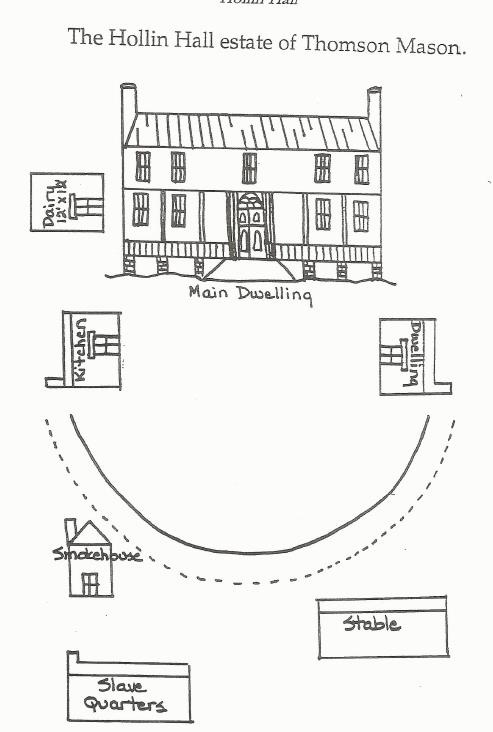
After his father George Mason IV died in 1792, Thomson inherited an additional 3,000 acres. To run such a large piece of property, several other buildings were erected including a kitchen, smokehouse, diary, slave quarters and stables (see schematic below). The original dwelling that was erected before Hollin Hall became a spinning house where weavers wove cloth for linens and clothing for the family and slaves. On the estate, Thomson and Sarah Mason raised 7 children – Sarah, Elizabeth, Ann, Thomson, William, George and Richard.
Pages
- Home
- About MHCA
- MHCA Calendar
- MHCA Announcements
- MHCA History
- MHCA Is Relevant Today!
- Benefits of MHCA Membership
- Importance of Email Address on File
- Neighborhood Map
- Pet Directory
- Useful Contact Information
- Emergency Services
- Utilities
- Other Useful Community Contacts
- MHCA Members Only
- Board Officers
- Committees
- MHCA Bylaws
- MHCA Board Files
- MHCA Resident Directories
- Newsletter Archive
- Photo Galleries
- Neighborhood Photos
- 2018 0909 MHCA Ice Cream Social
- 2018 0425 MHCA Annual Meeting
- 2017 Holiday Party
- Proposed MHCA Bylaws
- Community Projects
- 2015 Aircraft Noise Abatement
- 2013 Traffic Calming